.avif)

Introduction
If you run a small business in Sheffield, your Google Business Profile (GBP) is almost certainly more important than your website for generating local enquiries. It's the listing that appears when someone searches "plumber Sheffield," "kitchen fitter near me," or "IT support Sheffield" - before any website results, often before any ads.
The problem is that most Sheffield businesses either haven't set theirs up properly or set it up once and never touched it again. 67% of Google Business Profiles are incomplete: missing services, photos, opening hours, or attributes that directly affect whether you appear in local search results at all.
This guide walks through exactly how to set up and optimise your Google Business Profile in 2026, what factors matter most for appearing in Sheffield local searches, and what most businesses get wrong.
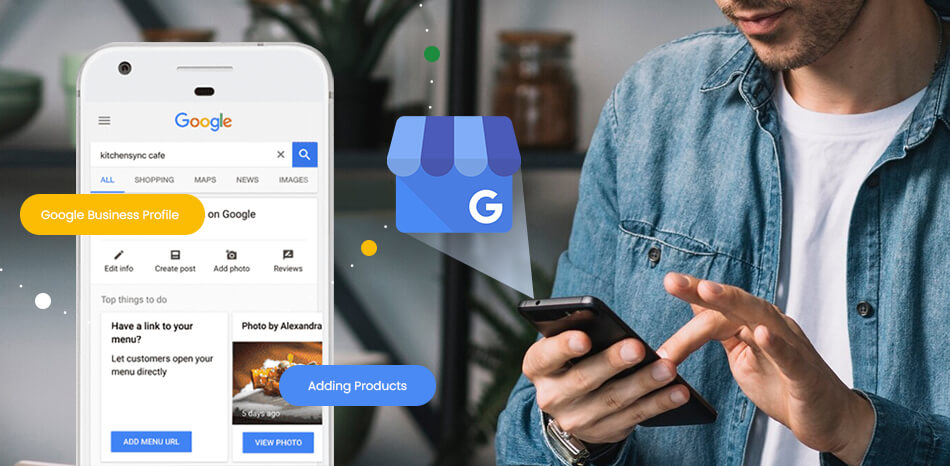
Why your Google Business Profile matters more than you think
Most business owners think of their GBP as a basic directory listing, somewhere to put your phone number and opening hours. It's far more than that. Your GBP is what determines whether you appear in the Local 3-Pack: the three business listings that appear at the top of Google results for local service searches, above all organic results and often above paid ads.
The data on what a well-optimised profile delivers is striking. Complete profiles receive 7× more clicks than incomplete ones. Businesses with 30 or more photos get 2.7× more clicks than those with fewer than 10. And 46% of all Google searches have local intent - meaning nearly half of all searches are from people looking for something nearby.
For a Sheffield trade or service business, appearing in those top three local results is the single highest-return SEO action available. It's free, it drives high-intent traffic, and it can be dramatically improved in an afternoon.
How to set up your Google Business Profile: step by step
Step 1: Create or claim your listing
Go to business.google.com and sign in with a Google account you'll use for the business. Search for your business name, Google may already have a listing for you that needs claiming. If not, click "Add your business to Google."
Use your exact legal business name. Don't add keywords to your business name (e.g. "Sheffield Plumber - Fast Response") — this violates Google's guidelines and can get your listing suspended. Your business name should match exactly what appears on your website, invoices, and signage.
Step 2: Choose your primary category carefully
This is the single most important decision you'll make for your GBP. According to local SEO experts, choosing the wrong primary category is the number one negative ranking factor for local search. Your primary category tells Google what type of business you are and determines which searches you're eligible to appear for.
Be as specific as possible. "Plumber" is better than "Contractor." "Kitchen Fitter" is better than "Home Improvement." You can add secondary categories to cover additional services, but your primary category should reflect your core offering. Take time to scroll through Google's full category list — the right one may be more specific than you expect.
Step 3: Set your service area
If you serve customers at their location (tradespeople, delivery businesses, mobile services), set a service area rather than a physical address. For most Sheffield small businesses, this means setting Sheffield and surrounding areas, you can add multiple postcodes or a radius.
Don't set your service area wider than you actually operate. Claiming to serve all of Yorkshire when you only take jobs in Sheffield and Rotherham will hurt your relevance scores for local searches in the areas that matter most to you.
Step 4: Complete every section of your profile
Most businesses stop at name, category, and phone number. The businesses that appear consistently in local results fill in everything. Work through this checklist:
- Business description: 750 characters maximum. Lead with your primary service and location in the first sentence. Mention Sheffield specifically. Include your key services naturally - don't keyword stuff.
- Opening hours: keep these accurate and update them for bank holidays. 62% of consumers will avoid a business if they find incorrect information online.
- Phone number and website: use a number you actively monitor. Link to your homepage or a relevant service page.
- Services list: add every service you offer with a description and price where possible. This feeds directly into what searches you appear for.
- Attributes: these vary by category but may include things like "free estimates," "veteran-led," "women-led," or "by appointment only." Add every attribute that applies.
- Q&A section: proactively add your own questions and answers covering your most common enquiries (pricing, availability, service area). These appear publicly on your profile.
Step 5: Add photos — more than you think you need
Photos are one of the highest-impact GBP optimisation actions available. GBPs with 30 or more photos get 2.7× more clicks than those with fewer than 10. Businesses with photos receive 42% more requests for directions and 35% more website visits than those without.
What to upload: exterior photos of your premises or van, photos of your work (before and after where relevant), team photos, product photos, and screenshots of any accreditations or certifications. Add new photos regularly, Google favours active profiles over stale ones. Aim for at least one new photo per month.
Avoid stock photography. Google can detect it and users respond far better to authentic images of your actual business and work.
Step 6: Get verified
Your listing won't show in search results until it's verified. Google typically offers verification by postcard (5–7 days), phone, or video. The options available depend on your business type. Choose the fastest option available to you and complete it promptly.
Once verified, your profile goes live and begins appearing in local searches. It typically takes 1–2 weeks for a newly verified profile to settle into stable positions in local results.
How to optimise your GBP to rank higher in Sheffield searches
Setting up your profile is just the start. The businesses that consistently appear in the Local 3-Pack for competitive Sheffield searches are actively managing their profiles. Here's what separates a top-ranking GBP from an average one.
Reviews: the most important ongoing factor
Review signals account for 16% of local pack ranking factors according to Whitespark's annual survey. More importantly, GBPs with 50 or more reviews win 4.4× more clicks than those with fewer than 5. The average GBP in 2026 has 47 reviews — if you have fewer than that, closing the gap is your highest-priority action.
The most effective way to get reviews is simply to ask every satisfied customer directly, ideally in person or via a follow-up text with a direct link to your review page. The businesses with the most reviews are rarely the biggest — they're the ones with a systematic process for asking.
Respond to every review, positive or negative, within 48 hours. Businesses that respond to reviews quickly see 18% higher review velocity than those that don't — meaning responding to reviews actually generates more reviews over time.
Google Posts: the underused ranking signal
Google Posts are short updates published directly to your GBP, similar to a social media post but appearing on your Google listing. Most Sheffield businesses never use them. The ones that do get a consistent signal of activity to Google that correlates with stronger local rankings.
Post at minimum once a week. Good post topics include: a completed job with photos, a current offer or promotion, a reminder of your services ahead of seasonal demand, or a link to a new blog post. Each post appears on your profile for 7 days before archiving.
Consistency across the web (citations)
Google cross-references your business name, address, and phone number (NAP) across the web to verify your legitimacy. If your details appear differently across directories, different phone numbers, old addresses, inconsistent business names — it creates a trust signal problem that suppresses local rankings.
Audit your listings on Yell, Checkatrade, Yelp, Bing Places, Apple Maps, and any industry-specific directories. Make sure your NAP details match your GBP exactly, character for character.
Common Google Business Profile mistakes Sheffield businesses make
Using a keyword-stuffed business name. Adding "Sheffield" or your service to your business name (e.g. "ABC Plumbing Sheffield Emergency Plumber") violates Google's guidelines. Listings with keyword-stuffed names are regularly suspended or stripped of their spam name by competitors reporting the violation.
Setting the wrong primary category. This is the single highest-impact negative ranking factor identified by local SEO experts. A kitchen fitter listed as a "General Contractor" is unlikely to appear for kitchen-specific searches regardless of how well-optimised the rest of the profile is.
Ignoring the services section. Many businesses fill in their business description but leave the services section empty. The services list feeds directly into keyword matching for local searches — an empty list means missed opportunities.
Not responding to negative reviews. A single unanswered 1-star review is far more damaging than the review itself. A professional, measured response demonstrates to every future customer reading the review that you take quality seriously. Ignoring it signals the opposite.
Only uploading photos at setup. Google treats a profile that hasn't been updated in months as less active and less relevant. A regular cadence of new photos, posts, and review responses tells Google your business is actively serving customers.
Google Business Profile vs paid ads: which should you prioritise?
This comes up often from Sheffield business owners trying to decide where to focus limited time and budget. The honest answer is they serve different purposes and ideally you do both — but if you have to choose, GBP first.
A fully optimised GBP delivers free, ongoing traffic from high-intent local searches with no ad spend required. Once it's ranking well, it works for you around the clock without an ongoing cost. Paid ads deliver faster results and are essential for reaching people outside your local area or scaling volume beyond what organic results provide — but they stop the moment you stop spending.
The strongest position is a well-optimised GBP generating consistent local leads alongside targeted paid ads capturing additional demand. If you're currently getting no leads from Google at all, optimising your GBP is the fastest path to changing that for free.
If you'd like help auditing your existing Google Business Profile or running paid ad campaigns alongside your local SEO, our free digital audit covers both. You can also read more about our paid ads management service for Sheffield businesses.
Your Google Business Profile is the foundation, but it works best as part of a complete system. See the full picture in our guide to digital marketing for Sheffield tradespeople.